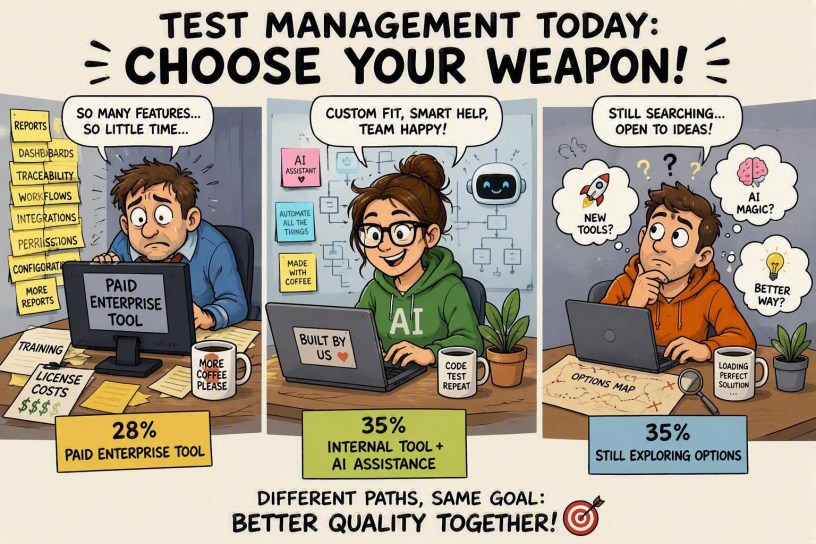
A few weeks ago, I asked a simple question on LinkedIn: What is your team’s approach to test management today?
Honestly, I expected paid enterprise tools to be the clear winner.
The results surprised me:
The results told a different story.

- 35% use internal tools with AI assistance
- 35% are still exploring options
- 28% rely on paid enterprise tools
The most interesting result is not that enterprise tools came last.
The real surprise is that 70% of respondents are either building their own solution or are still looking for one.
That made me wonder: Are test management tools losing the value they once had?
The Golden Age of Test Management Tools
For many years, test management tools were a natural choice.
They helped teams:
- Store test cases
- Track execution
- Create reports
- Ensure traceability
- Support audits and compliance
For large organizations, these tools became part of the testing process itself. They provided a common language and a central place where testing activities could be managed.
But the testing world has changed significantly since then.
The Rise of Lightweight Solutions
Today, many teams work differently.
Some manage tests directly in Jira or Azure DevOps.
Others create internal portals connected to their own ecosystem.
And yes, some teams still rely on a surprisingly powerful Excel spreadsheet.
The goal is often the same: keep things simple.
Rather than adapting their way of working to fit a tool, teams increasingly build solutions that fit their context, processes, and constraints.
Have you noticed the same trend in your organization?
Is AI Changing the Game?
I believe AI is also contributing to this shift.
Today, AI can help generate:
- Test ideas
- Test cases
- Test data
- Reports
- Summaries
This raises an interesting question.
If tests can be generated, updated, reviewed, and summarized more easily than before, do we still need repositories containing thousands of manually maintained test cases?
For some organizations, especially regulated industries, the answer may still be yes.
For others, the answer is becoming less obvious.
The Cost We Rarely Discuss
When discussing test management tools, we often focus on licensing costs, integrations, and features.
But what about maintenance?
A repository only creates value if it remains relevant.
How many teams have hundreds or even thousands of test cases that nobody has reviewed in months?
How many dashboards are generated automatically but rarely consulted?
How many reports exist because the process requires them rather than because someone actually uses them?
Sometimes the challenge is not managing tests.
It is managing the management of tests.
Are Test Management Tools Disappearing?
The famous testing answer is:
“It depends.”
It depends on several factors:
- What challenges does the organization face?
- What level of traceability is required?
- Does the team have the budget for a commercial solution?
- Does maintaining the tool create more value than effort?
- Can the tool evolve quickly enough in the age of AI?
Highly regulated industries still need strong traceability, documentation, and audit evidence.
In these contexts, dedicated test management tools remain extremely valuable.
However, I believe their role is evolving.
The question is no longer:
Which test management tool should we buy?
The question is becoming:
What problem are we trying to solve?
If a commercial platform solves it, great.
If an internal solution solves it better, that is also fine.
If AI can simplify part of the process, even better.
A Personal Reflection
One thing that struck me in the poll results is how many teams are successfully working without large enterprise platforms.
It reminded me that we are not obligated to have the fanciest tool to build a good test management approach.
Sometimes, a lightweight solution adopted by the entire team can create more value than an enterprise tool that nobody enjoys using.
It also made me think about one of my favorite lines from the Agile Manifesto:
“Individuals and interactions over processes and tools.”
This principle does not mean tools are unimportant.
It reminds us that tools should support collaboration, not replace it.
The best test management solution is not necessarily the most powerful one.
It is the one that helps people collaborate, make informed decisions, and build confidence in the quality of their product.
Final Thought
Maybe the future of test management is not about choosing between enterprise tools, internal tools, or AI.
Maybe it is about finding the simplest solution that creates the most value.
Because at the end of the day, teams do not need a test management tool.
They need confidence in the quality of their product.
What about your team? Has your approach to test management changed over the last few years, or are traditional tools still delivering the value you need? 👇

