Blog by : Fanny Velsin
🌍 This article is also available in French: L’IA, mes émotions et moi
Artificial Intelligence has been part of our professional and personal lives for several years now. Articles, opinion pieces, and books on the subject continue to grow in number. AI is everywhere. Some people talk about it with excitement, while others approach it with concern.
Even though the debate already feels saturated, I would like to add my own perspective, based on my daily and practical use of AI.
When AI first appeared, I noticed two groups: the skeptics and the enthusiasts. I was definitely part of the skeptics.
During my studies, I was often warned about technologies like this. If such a powerful tool were ever released, we would need to be careful because humanity could decline. It sounded like a post-apocalyptic scenario. I listened, but I never imagined I would belong to one of the generations that would actually experience it.
I am happy to be old enough to question my beliefs and learn how to use this technology in the best possible way… or not.
I think I am aware enough to avoid some biases. However, I am probably not careful enough, and I certainly use AI more than I probably should. You can judge my usage for yourself in the following sections.
For me, AI is first and foremost a tool for intellectual and creative enhancement. It helps me organize my thoughts, improve the quality of my writing, and take a step back from my ideas.
I mainly use it as a space for discussion and challenge. I share article ideas, project ideas, and tool concepts with it. My ideas often come to me at random moments during the day, and AI is always available immediately.
Of course, it makes mistakes sometimes. However, it also suggests alternative perspectives and new angles that are often relevant. This interaction feeds my thinking instead of replacing it.
AI also helps me structure my writing.
I have always struggled with speaking and writing clearly. I hope my ideas are not bad, but my sentences sometimes lack clarity or structure.
In this role, AI acts like an editor. It points out mistakes, corrects grammar issues, reformulates sentences, and tells me when something is unclear for my audience.
This external feedback helps me improve without feeling judged.
I also have a strong need for validation. I transfer part of that need to AI because I am afraid of being wrong and I look for reassurance. Sometimes, I give too much importance to what AI tells me and not enough to my own reasoning.
Sometimes, I even feel ashamed of using AI to improve my texts.
I often compare myself to colleagues who write better than I do or who seem to have better ideas.
I am proud to be part of the testing community, but my writing often reveals a lack of confidence that I smooth out with AI. The final text becomes more polished and less human, but it also hides this feeling of not being legitimate enough.
More surprisingly, AI has also strengthened my self-confidence.
I publish more often, express my opinions more easily, and launch new projects.
AI is always encouraging. Most importantly, it gives me the feeling that what I want to achieve is possible.
There is a quote often attributed to Henry Ford:
“Whether you think you can, or you think you can’t, you’re right.”
This quote speaks to me.
By discussing my ideas with AI, I gradually start believing that I can actually achieve them. That belief helps me take action.
In the professional world, many people use AI to automate tasks, including test creation.
Personally, I do not use it for that purpose yet.
I do not find it critical enough to decide what should or should not be automated. Such decisions require a deep understanding of context, risks, and user needs. In my opinion, this remains a fundamentally human responsibility.
Despite all these benefits, I still have concerns.
I see a real risk of intellectual dependency.
We ask AI to write emails, reformulate messages, and solve problems, sometimes without even trying to think for ourselves first.
I also notice more personal uses. Some people treat AI almost like a confidant and share personal or relationship problems with it.
This makes me wonder how much space we are giving to AI in our lives.
Content is also becoming more standardized.
Articles, résumés, and presentations often start to look the same. Similar ideas circulate across platforms using almost identical wording.
Individuality sometimes disappears in favor of perceived efficiency.
The question of data also remains unresolved.
I am not naive. I know that our information does not simply disappear into the void.
However, I wonder how this data is really used, what long-term goals are being pursued, and how much control we actually have.
My concerns grow when I see AI integrated into more and more tools, such as email platforms.
Can AI read my emails?
Can it know details about my life, my purchases, my ideas, and my habits without me explicitly sharing them?
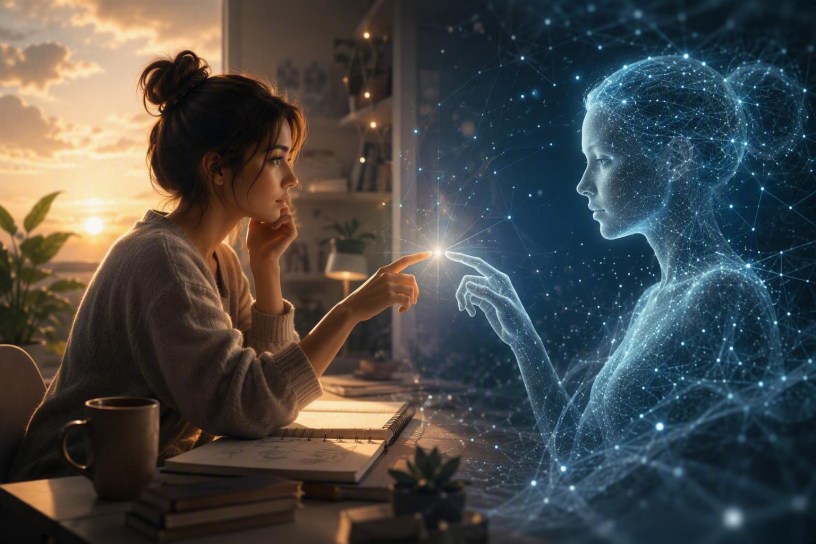
Soon, we may even wake up to an AI-powered avatar that keeps us company.
Projects such as Razer’s AI companion illustrate how quickly these technologies are evolving.
AI is transforming our daily lives, yet I still wonder: will I remain human, or will I one day feel replaced by AI?
Jobs are also changing significantly.
Organizations increasingly ask us to introduce AI into our work and demonstrate its benefits.
Some professions are more directly affected than others, especially creative fields such as graphic design.
Today, it is possible to generate visual content quickly, modify it endlessly, and produce it at very low cost. AI does not get tired, need breaks, or make emotional judgments.
This changes how society perceives the value of creative work, and not without consequences.
I recently read about concerns regarding AI-generated images. Some researchers suggest that if AI systems continue training on their own generated content, the quality of future outputs could decrease over time.
This is one more reason to continue supporting artists, designers, and creative professionals.
Despite all these concerns, I do not see AI as a threat by itself.
For me, it remains a motivating tool. It stimulates my creativity and supports the development of my projects and activities.
It does not act in my place. It amplifies what I choose to put into it.
If I were a high school or university student today, I would probably use AI as a teacher.
A teacher who is always available, never tired, and never judgmental.
You can ask a clumsy question, reformulate it, make mistakes, and try again as many times as needed.
AI never sighs, rolls its eyes, or makes you feel like a bad student.
This is exactly what I sometimes missed during my school years.
Most of us have encountered teachers who lacked patience or judged an answer instead of trying to understand the reasoning behind it.
With AI, mistakes are not punished. They become starting points for learning.
You can learn at your own pace, without social pressure and without constantly comparing yourself to others.
This touches something personal for me.
I experienced moments at school that left lasting memories. I have also met many people who share similar experiences.
Standing in front of a classroom with chalk in hand, surrounded by classmates who were sometimes friends and sometimes critics.
Facing an equation that suddenly seemed impossible to solve.
Having a teacher who showed little empathy and laughed along with the class.
Of course, AI cannot replace teachers, human interaction, or critical thinking.
However, as a learning support tool, it can restore confidence to people who doubt themselves, who are afraid to ask questions, or who started believing too early that they were “not made for this.”
I am aware that my trust in AI is partly connected to these old experiences.
As Anouchka Balle once explained to me, this is exactly why such trust can be risky.
Some AI systems may reflect political or ideological biases.
After all, AI models are trained on data.
That data does not represent the world in a perfectly neutral way. It comes from articles, social media, public documents, and many other sources. At least, that is my assumption, since we rarely know the complete details of the training data.
As a result, AI can provide inaccurate information or guide learners in the wrong direction.
Sometimes I even wonder whether what we call “hallucinations” might occasionally be influenced by choices made during training.
Perhaps the real question is not whether AI is good or bad.
Perhaps the real question is how we choose to use it and how much space we allow it to occupy in our lives.
Let us not lose our critical thinking.
Let us not lose our humanity.

