Last week, I had the opportunity to join the very first edition of the training program “Vers une transition écologique heureuse” (Towards a Happy Ecological Transition), organized through our company Sogeti / Capgemini.
I registered for this training because I felt a growing need to better understand the environmental and social challenges shaping our future. In an era driven by artificial intelligence, cloud computing, digital services, and constant connectivity, we often celebrate innovation without fully reflecting on its environmental footprint. As technology professionals, we help build the digital world of tomorrow, but we also have a responsibility to understand its impact on our planet.
Over two inspiring days, I explored topics ranging from planetary boundaries and the Doughnut Economy to climate action scenarios and the power of collective narratives. The training combined scientific insights, collaborative workshops, and practical reflection, offering not only a deeper understanding of ecological transition but also concrete reasons for optimism.
As a Quality Engineer, I often think about continuous improvement, systems thinking, and long-term impact. This experience challenged me to apply the same mindset to environmental and social issues, while reminding me that sustainable change requires both individual action and collective transformation.
Understanding the Bigger Picture
The first part of the training focused on the environmental and social challenges facing our world today.
One concept that particularly stayed with me was the framework of the Planetary Boundaries, developed by scientist Johan Rockström. The idea is simple but powerful: our planet has ecological limits that define a safe operating space for humanity. Crossing these limits increases the risk of destabilizing the Earth systems that support life. According to the training materials, several of these boundaries have already been exceeded.
The video explaining the nine planetary boundaries helped transform abstract environmental discussions into something much more tangible. Instead of seeing climate change as a single issue, I began to understand it as part of a much larger interconnected system involving biodiversity, freshwater, pollution, land use, and many other factors.
One lesson became clear: sustainability is not only about reducing emissions. It is about respecting the ecological conditions that make human life possible.
Discovering the Doughnut Economy
Another highlight was learning about Kate Raworth’s Doughnut Economics.
The doughnut model introduces two essential boundaries:
- An ecological ceiling that humanity must not exceed.
- A social foundation below which no person should fall.
The goal is to create a “safe and just space” where everyone’s needs are met while staying within planetary limits.
What I appreciated most about this model is its balance. Too often, environmental discussions focus only on restrictions, sacrifices, or alarming figures. The doughnut framework reminds us that ecological transition should also improve people’s lives, well-being, health, education, and access to opportunities.
It is not about choosing between people and the planet. It is about building a future that works for both.
A Place That Embodies the Transition
The training took place at the Maison de la Planète in Boulogne-Billancourt, a former school transformed into a hub dedicated to ecological transition.
Maison de la Planète de Boulogne-Billancourt – YouTube
Beyond the presentations, the venue itself was inspiring. Repair workshops, second-hand initiatives, plant exchanges, and low-tech demonstrations showed that sustainability is not just a concept discussed in conference rooms. It can become a visible and practical part of daily life.
Sometimes, seeing concrete examples has a greater impact than reading statistics.
The 2 Tonnes Workshop: From Awareness to Action
During the afternoon, we participated in the 2 Tonnes workshop, an interactive simulation that projects participants into the year 2050.
Before attending, we had calculated our individual carbon footprint. During the workshop, we explored how individual choices, business decisions, technological innovations, and public policies could collectively contribute to achieving carbon neutrality.
What surprised me most was the importance of collective action.
We often hear advice such as:
- travel less,
- consume differently,
- reduce waste.
These actions matter, but the workshop demonstrated that achieving climate goals also requires systemic changes in transportation, housing, energy production, industry, and governance.
The most encouraging takeaway?
While the challenge is substantial, the transition remains achievable if individuals, organizations, and institutions move in the same direction.
Why Stories Matter More Than Facts
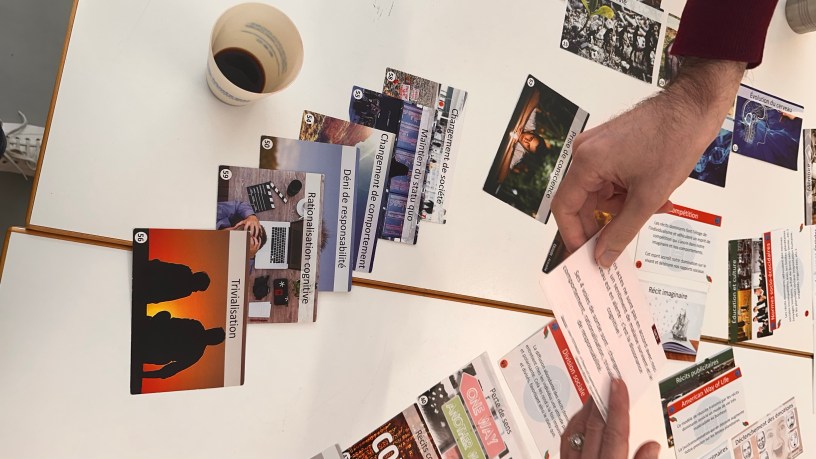
The second day introduced another fascinating topic through La Fresque des Nouveaux Récits, co-created by Benoît Rolland de Ravel.
This workshop explored a question that I had never seriously considered:
If we already know the environmental facts, why is change still so difficult?
The answer lies partly in the stories that shape our beliefs, aspirations, and decisions.
For decades, dominant narratives have promoted ideas such as:
- endless growth,
- unlimited consumption,
- success measured by accumulation,
- technology always solving every problem.
These stories influence our behaviours more deeply than statistics ever could.
The workshop showed how new narratives can help society imagine a future that is both desirable and sustainable. Because before creating a different world, we first need to be able to imagine it.
As someone who works in change management and quality coaching, this insight resonated strongly with me. Data helps people understand. Stories help people move.
Thinking in the Long Term
Another topic addressed during the training was our relationship with time.
In a world driven by short-term results, immediate gratification, and quarterly objectives, we were encouraged to think on a much longer horizon. What kinds of decisions would we make today if we genuinely considered future generations? What legacy do we want our organizations and communities to leave?
This perspective challenged me to reconsider how success is measured.
Some of the most valuable actions may not generate immediate benefits. Their real impact may only become visible years or decades later.
My Key Takeaways
After two days of discussions, workshops, and reflection, I left with five major lessons:
1. Environmental challenges are systemic
Climate change cannot be understood in isolation. It is connected to biodiversity, resources, social equity, economics, and human behaviour.
2. Facts are necessary but not sufficient
People rarely change because of information alone. Meaningful change requires emotion, imagination, and compelling narratives.
3. Individual actions matter, but collective action matters more
Personal responsibility is important, yet systemic transformation is essential to reach meaningful impact.
4. A positive vision is powerful
Fear may create awareness, but hope creates engagement. People are more likely to support a transition when they can imagine a desirable future.
5. The future is still open
Perhaps the most important lesson of all: the ecological transition is not a predetermined story. It is something we are actively writing together.
Final Thoughts
I joined this training to strengthen my understanding of sustainability challenges. I left with something even more valuable: a deeper appreciation of systems thinking, collective responsibility, and the importance of shaping the future through the stories we choose to tell.
As a Quality Coach and Test Manager, I spend much of my time helping teams look beyond individual defects to understand the wider system that creates them. This training reminded me that environmental challenges require a similar mindset. Complex problems rarely have a single cause or a single solution. Meaningful progress comes from understanding interdependencies, questioning assumptions, and aligning individual actions with collective goals.
One of my biggest takeaways is that ecological transition is not only an environmental challenge. It is also a human challenge. Facts and data are essential, but lasting change happens when people can connect with a shared vision of a desirable future.
A successful ecological transition is therefore not just about reducing our footprint. It is about creating conditions where both people and the planet can thrive within sustainable boundaries.
If there is one message I will carry forward from these two days, it is this:
The transition is not about sacrificing today’s quality of life to avoid tomorrow’s problems. It is about intentionally designing a future that is more resilient, more equitable, and more desirable for everyone.
My sincere thanks to the 3 facilitators and participants who made this experience so enriching. The workshops provided not only knowledge, but also perspective, hope, and a renewed sense of responsibility. The conversations may have lasted two days, but the reflections will stay with me much longer.

