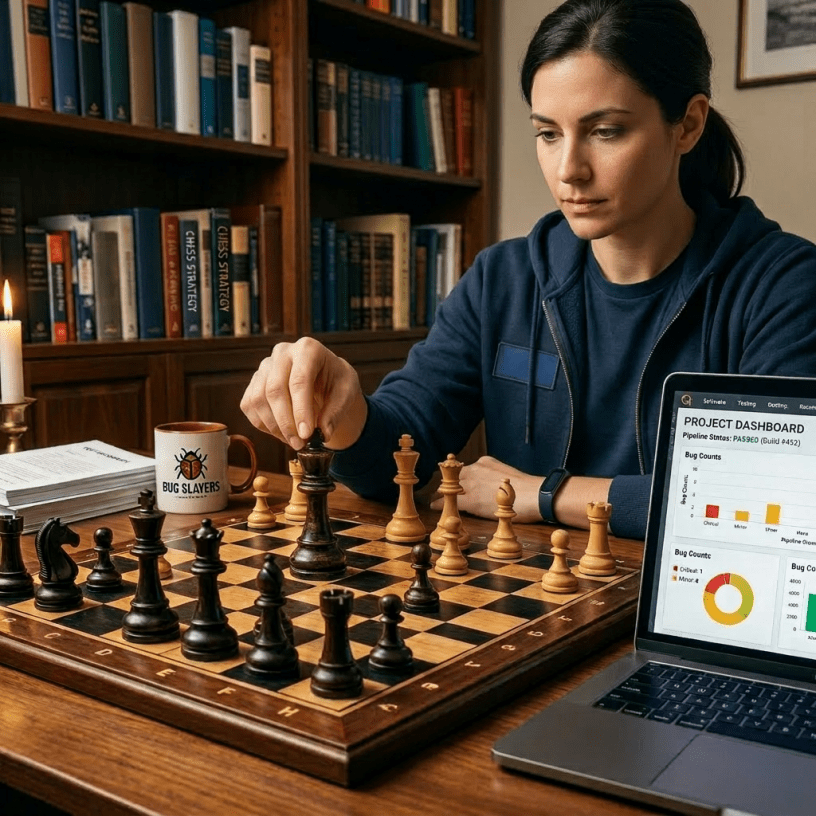
I play chess regularly.
Real matches. Real opponents.
Mostly on Duolingo real‑time games.
And most of the time, I win.
Not because I play faster.
Not because I play more moves.
But because I play with intention.
Of course, I lose sometimes too.
And those games stay with me longer.
Because every loss exposes something I missed.
A risk I underestimated.
A move I played too quickly.
A situation I thought was covered… but wasn’t.
And every time, I think the same thing:
This feels exactly like testing.
♟️ When Activity Looks Like Strategy
In chess, it’s easy to look busy.
Pieces move.
Pawns advance.
The board fills up with action.
From the outside, it looks strong.
But without a plan, all that movement means nothing.
I’ve lost games where I had many pawns on the board—
because I kept sending them forward without purpose.
One by one, they disappeared.
Testing can look exactly the same.
More test cases.
More scenarios.
More execution.
Yet risks remain untouched.
We confuse activity with coverage.
🧪 A Tester’s Brain Thinks Like a Chess Player
A good chess player doesn’t try to control every square.
They focus on:
- protecting the king
- controlling critical positions
- anticipating future threats
- deciding which pieces truly matter
A good tester does the same.
Testing is not about checking everything.
It’s about covering what could cause real damage.
Risk of losing a chess game
is no different from
risk of failure in software.
Both require:
- prioritization
- anticipation
- sacrifices
- and strategic timing
Sometimes, letting a pawn fall is the right move.
Sometimes, not testing a low‑value scenario is smart.
♜ More Scenarios Don’t Mean More Coverage
Filling a test suite with low‑impact scenarios
does not protect the system.
Just like having many pawns
doesn’t protect the king.
Without coordination, they fall.
Slowly. Quietly.
True test coverage isn’t wide.
It’s focused.
It protects what matters most. It exposes weak points early. It makes risk visible—before failure does.
♞ Why Good Testers Win More Than They Lose
Strong chess players pause before they move.
They ask:
If this fails, what do I lose?
That question is pure testing.
Good testers don’t chase numbers.
They chase understanding.
They challenge assumptions. They think ahead. They design coverage around impact—not volume.
And when they lose?
They don’t add random moves next time.
They adjust their strategy.
Failure isn’t noise.
It’s feedback.
✨ Final Thought
Chess taught me this: Winning is not about playing more. It’s about protecting what matters.
Testing is the same.
Cover risks—not everything.
Choose value—not volume.
Think before you move.
Because in testing, like in chess,
the real goal is simple:
Don’t lose the game where it matters most. ♟️

