Blog by : Imen NAGUEZ
🌍 This article is also available in French: Les questions dites « bêtes » sont rarement inutiles – Imen NAGUEZ
How AI unlocks the questions we’re too afraid to ask anywhere else
You know the moment.
Someone explains something, everyone nods, and somewhere in your mind a phrase is trying to get out:
“What exactly is that?”
“Could you explain again?”
“I don’t see the connection.”
You keep it to yourself.
Not because you’re less intelligent than the others, but because asking that question carries a social cost you’re not ready to pay.
AI doesn’t make people smarter by magic.
What it does, however, is reduce that cost.
And that shift, seemingly minor, can profoundly transform the way we learn, think, and grow.
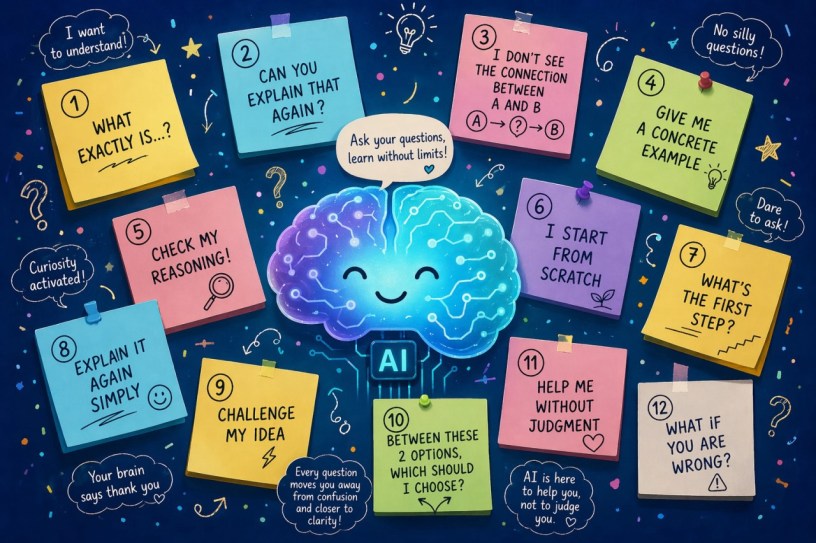
Here are 12 concrete situations. For each: what happens without AI, what becomes possible with it, and what the research says about it.
The real problem isn’t the question — it’s other people’s reactions
In a classroom, a meeting, a training session, or even among colleagues, some questions seem tiny, but they expose a lot.
Asking “what exactly is that?” can feel like admitting you weren’t following.
Asking again can feel like appearing slow.
Saying “I don’t understand the link” can feel like displaying a flaw in your thinking.
The block is almost never intellectual to begin with.
It’s relational.
“Teams learn more when members feel they can take an interpersonal risk without being immediately disqualified or ridiculed.”
Amy Edmondson, Psychological Safety and Learning Behavior in Work Teams (1999)
In other words: when the cost of judgment drops, asking a question becomes possible.
And when you can finally ask, real learning can begin.
12 questions we don’t dare ask — and what AI changes
For each situation: the reality without AI, what becomes possible with it, and what the research says.
🤔 1. “What exactly is…?”
❌ Without AI
The question comes too late, gets sidestepped, or people just guess.
Fear of judgment takes over: looking incompetent, appearing like you weren’t paying attention.
Result: an entire line of reasoning built on a shaky foundation.
✅ With AI
You ask directly for a definition, a rephrasing, or a simpler explanation.
No sighs. No looks.
Result: the concept is clarified from the start, and you move forward on solid ground.
🔬 What the research says
When the risk of judgment decreases, asking for clarification becomes natural. Amy Edmondson showed that psychological safety, the feeling that you can speak up without being ridiculed, is one of the strongest predictors of real learning.
(Edmondson, 1999)
🔄 2. “Can you explain that again?”
❌ Without AI
You pretend to have understood so as not to bother anyone.
You take confused notes, retain little, and memorize poorly.
Embarrassment wins over learning.
✅ With AI
You ask as many times as you need, in different ways if necessary.
No sighs. No impatience.
You consolidate the foundations and move forward on stable ground.
🔬 What the research says
Asking for help often carries a high social cost. Ryan and Shin showed that students who dare to ask for help at the right moment, what they call adaptive help-seeking, achieve significantly better outcomes than those who avoid the question out of fear.
(Ryan & Shin, 2011)
🔗 3. “I don’t see the connection between A and B”
❌ Without AI
You don’t dare admit you can’t follow the logic between two ideas.
You retain isolated fragments without ever grasping the mechanism linking them.
✅ With AI
You ask for a step-by-step walkthrough, a logical diagram, or an intermediate example.
The lack of understanding becomes a legitimate starting point, not a source of shame.
🔬 What the research says
Precisely naming what is missing does not block learning. On the contrary, it often activates a clarification process.
Chi et al. showed that learners who self-explain, who verbalize missing links, build far deeper understanding than those who stay passive.
(Chi et al., 1989)
💡 4. “Give me a concrete example”
❌ Without AI
You don’t dare look like a beginner.
You understand in theory but retain poorly and struggle to apply it.
The abstract stays abstract.
✅ With AI
You ask for one or several examples, even a counter-example.
You see how the concept works in real life.
You retain better and can transfer it to other situations.
🔬 What the research says
Worked examples, pre-solved and guided illustrations, are especially effective for novices.
Atkinson et al. demonstrated that well-structured guidance with resolved examples significantly accelerates learning.
(Atkinson et al., 2000)
🔍 5. “Check my reasoning!”
❌ Without AI
In public, you protect your image.
You avoid exposing a still-fragile line of thinking.
You spot your mistakes too late and correct them with difficulty.
✅ With AI
You submit your reasoning and explicitly ask:
“Where does it break down?”
“Which assumption is weak?”
You detect flaws earlier, correct faster, and raise your level of rigor.
🔬 What the research says
Hattie and Timperley showed that the most useful feedback is not just validation.
It is precise information that helps understand where you are, where you’re going, and what needs adjusting.
(Hattie & Timperley, 2007)
🌱 6. “I start from scratch?”
❌ Without AI
You hide your real level and overcompensate.
You try to appear already autonomous.
You skip essential steps, exhaust yourself, and progress less than you could.
✅ With AI
You embrace starting from the basics.
You ask for a fundamental, progressive, structured explanation.
You make real progress and build solid foundations.
🔬 What the research says
Acknowledging your gaps takes courage.
But when the pressure of others’ judgment decreases, this honesty becomes possible and often marks the beginning of lasting learning.
(Edmondson, 1999)
🗺️ 7. “What’s the first step?”
❌ Without AI
You want to appear autonomous.
You avoid asking where to begin.
You scatter your efforts, start too broad, and lose energy and efficiency.
✅ With AI
You ask for a minimal plan and a clear first action.
The mental load drops immediately.
You move forward step by step and regain a sense of control.
🔬 What the research says
Research on cognitive load shows that breaking down a complex task into simple steps significantly improves perseverance and outcomes.
(Sweller, 1988)
🪜 8. “Explain it again simply”
❌ Without AI
You don’t dare ask for a very simple version for fear of being seen as “not at the right level.”
You stay confused and understand only partially.
✅ With AI
You ask for a simple explanation first, then gradually increase complexity.
You build understanding step by step.
🔬 What the research says
Learning through gradation is often more effective than diving straight into complexity.
Progressive formative feedback tends to be more useful than an expert explanation delivered all at once.
(Shute, 2008)
⚔️ 9. “Challenge my idea”
❌ Without AI
You dread contradiction because it feels like a personal attack.
You avoid objections and miss your blind spots.
✅ With AI
You deliberately ask for objections, possible criticisms, and ways to test them.
You spot your biases and strengthen your idea before reality does the testing for you.
🔬 What the research says
Actively seeking objections improves reasoning quality and reduces blind spots.
It is critical thinking in action.
(Hattie & Timperley, 2007)
⚖️ 10. “Between these 2 options, which should I choose?”
❌ Without AI
You hesitate without clearly articulating your doubt.
You stay stuck and sometimes decide without explicit criteria.
✅ With AI
You ask for a structured comparison:
- Criteria
- Advantages
- Risks
- Trade-offs
- Use cases
You make a more reasoned and coherent choice.
🔬 What the research says
The quality of a decision increases when it rests on explicit criteria rather than unverified intuition.
(Kahneman, 2011)
🫂 11. “Help me without judgment”
❌ Without AI
You don’t voice this need because you think you should handle your confusion alone.
You learn less effectively and risk closing yourself off.
✅ With AI
You clearly state that you want calm, non-judgmental, progressive guidance.
You become a learner again.
Your real questions surface.
A constructive dynamic takes hold.
🔬 What the research says
When the relational cost is lower, it becomes easier to ask for a reassuring framework, and authentic learning becomes possible again.
(Edmondson, 1999)
🧐 12. “What if you are wrong?”
❌ Without AI
You verify through your usual sources, your experience, or the opinion of others.
Sometimes in a slower or less structured way.
✅ With AI
You can ask for sources, assumptions, limitations, uncertainties, and a verification method.
You use AI as an exploration tool, not an absolute authority.
🔬 What the research says
A fluent answer is not necessarily a correct one.
The easier the exchange becomes, the more important it is to verify, compare, and validate.
(Shute, 2008)
In truth, these questions take courage
When someone asks “what exactly is that?” or “I’m starting from scratch,” they are not necessarily showing a lack of ability.
They are often showing a genuine willingness to understand.
What blocks most people, most of the time, is not a lack of intelligence.
It’s the fear of exposure.
“Avoiding help-seeking out of fear of others’ judgment deprives the learner of essential resources, while adaptive help-seeking is directly linked to better outcomes.”
Ryan & Shin, Help-seeking Tendencies During Early Adolescence (2011)
AI, used thoughtfully, replaces neither human pedagogy nor intellectual rigor.
But it offers something valuable:
a space where you can start small, try again often, ask simply, ask clearly, ask for objections, and ask for verification.
Without putting your image on the line.
And sometimes, that’s exactly what it takes for learning to stop being a performance and become real understanding again.
References
Atkinson, R. K., Derry, S. J., Renkl, A., & Wortham, D. (2000). Learning from examples: Instructional principles from the worked examples research. Review of Educational Research, 70(2), 181–214.
Chi, M. T. H., Bassok, M., Lewis, M. W., Reimann, P., & Glaser, R. (1989). Self-explanations: How students study and use examples in learning to solve problems. Cognitive Science, 13(2), 145–182.
Edmondson, A. (1999). Psychological Safety and Learning Behavior in Work Teams. Administrative Science Quarterly, 44(2), 350–383.
Hattie, J., & Timperley, H. (2007). The Power of Feedback. Review of Educational Research, 77(1), 81–112.
Kahneman, D. (2011). Thinking, Fast and Slow. Farrar, Straus and Giroux.
Ryan, A. M., & Shin, H. (2011). Help-seeking tendencies during early adolescence. Learning and Instruction, 21(2), 247–256.
Shute, V. J. (2008). Focus on Formative Feedback. Review of Educational Research, 78(1), 153–189.
Sweller, J. (1988). Cognitive load during problem solving: Effects on learning. Cognitive Science, 12(2), 257–285.
Fournissez vos commentaires sur BizChat
 Emna Ayadi